online store · marketplace · small business
Your Own Online Store or a Marketplace? A Practical Comparison for Small Brands
Marketplaces bring buyers; your own store gives you the brand and the customer list. Costs, risks and how small sellers combine both, with examples.
This article is also available in Bahasa Indonesia
Contents · 7
A marketplace hands you buyers who are already shopping; your own online store hands you control of the brand, the prices and the customer list. Marketplaces take a fee on each sale and set the rules, while your own store pays no platform commission but depends on you to bring in visitors. That is why most small brands end up using both, each for a different job.
This comparison is written from Indonesia, where Shopee, Tokopedia and TikTok Shop dominate, but the trade-offs are the same on Amazon, Etsy or any other platform.
How do the two compare?
| Aspect | Marketplace | Your own store |
|---|---|---|
| Visitors | Already there, searching inside the app | You bring them: search, social media, past customers |
| Selling costs | Platform fees per order, set by the platform | No platform commission; payment-gateway fees if you take card or e-wallet payments |
| Up-front cost | Close to zero | Building the site, then yearly domain and hosting |
| Customer data | Held by the platform; sellers see a limited view | Yours: contacts, order history and marketing consent |
| Competition | Your product sits next to rivals' | Visitors only see your products |
| Look and brand | The platform's template | Your design, story and photography |
| Rules | Can change at any time | Yours to set |
Marketplace fees vary by platform, product category and the programmes you join, and they change often; in 2026 alone the commission cap on TikTok Shop by Tokopedia changed several times. Check each platform's official seller centre before you work out your margins.
What does the data say about marketplaces in Indonesia?
Indonesia's statistics agency, BPS, found that in 2023 almost a third (32.74%) of e-commerce transaction value went through marketplaces. It also lists the risks: limited access to customer data, manipulated rating and recommendation algorithms, unequal competition with the platform owner, and one-sided rule changes and delisting.
Platform rules make the data point concrete. TikTok Shop by Tokopedia's customer communication policy, for example, forbids sellers from directing customers off-platform, including sending external links, QR codes, offline store addresses or personal contact details. A customer you win on a marketplace largely remains the platform's customer.
When is a marketplace enough on its own?
- Your products are found through generic searches and buyers compare prices inside the app.
- Orders are still few and you have no regular customers yet.
- You do not yet have time for photos, copy and promotion for a separate store.
- Your sales depend on the platform's free-shipping or campaign programmes.
When is your own store worth it?
- Customers come back. Repeat buyers can order directly without passing your competitors' listings.
- You make things to order, with sizes, finishes or engraving that do not fit a marketplace description box.
- You sell wholesale or to businesses, including overseas buyers who expect a catalogue, specifications and a quote request form.
- You are building a brand, with room for your story, your process and reviews under your own name.
- You want a fallback if a marketplace account is suspended or the rules change overnight.
How do sellers run both?
- Use the marketplace for discovery. List your best sellers there and play by its rules.
- Use your store for loyalty and special orders. Put a small card with your store's address in every parcel.
- Keep one reference price so buyers are not confused, and explain any differences in shipping or extras.
- Link everything together: the website links to your marketplace shop, Google Business Profile and WhatsApp; your social bios link to the website.
Should you start simple or fully featured?
| What you need | PintuWeb package | Price | Turnaround |
|---|---|---|---|
| Product catalogue, orders via WhatsApp | Simple Online Store | IDR 300,000 – IDR 2,000,000 | 3–5 working days |
| Basket, payment gateway, automatic shipping rates, order dashboard | Full Online Store | IDR 3,000,000 – IDR 10,000,000+ | 5–8 working days |
The simple store suits a business that can still handle orders by chat. Once replying to every order becomes the bottleneck, the full store takes over. Payment-gateway transaction fees are charged by the gateway provider under its own terms, not by us. Prices are in Indonesian Rupiah (IDR).
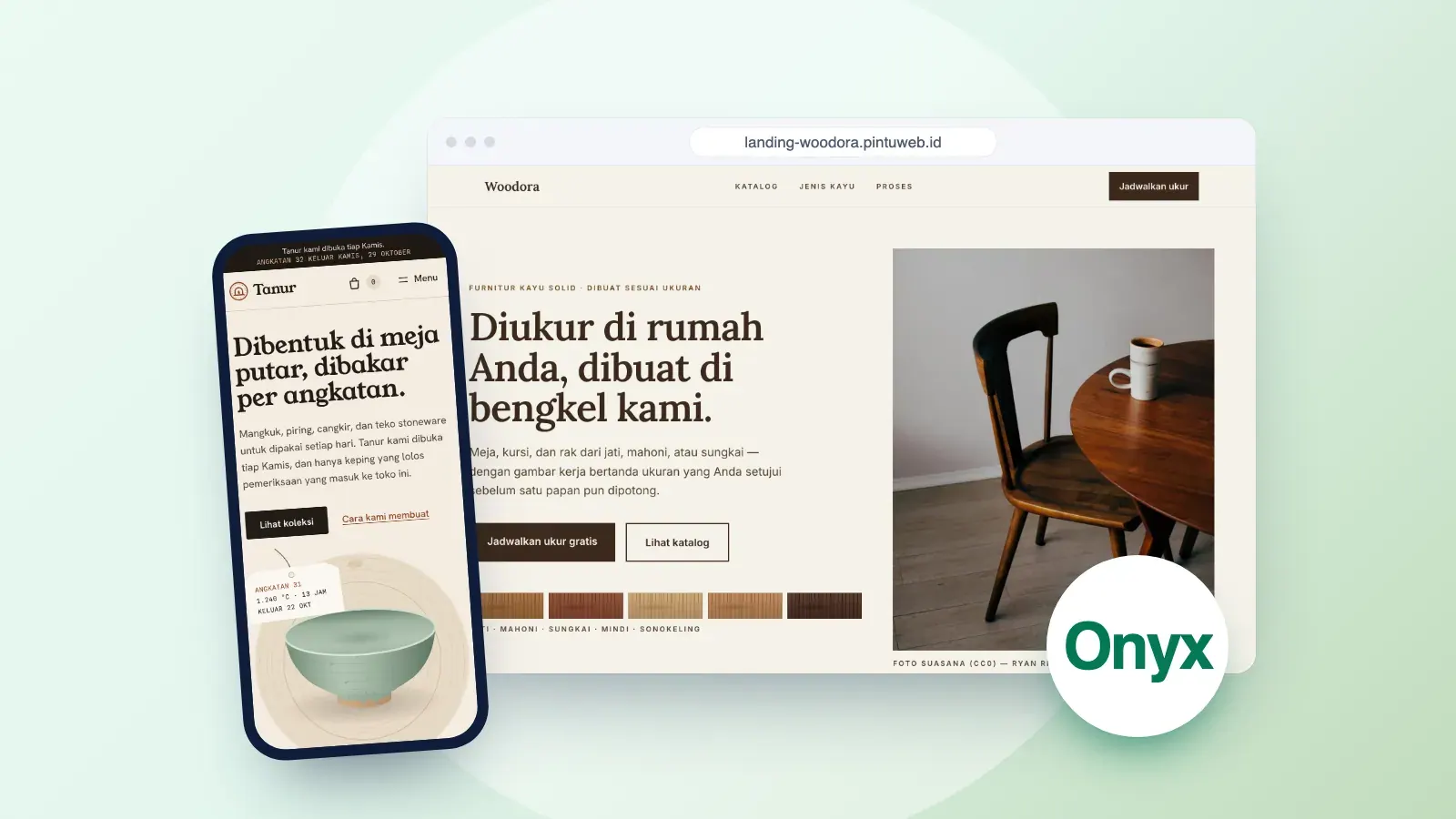
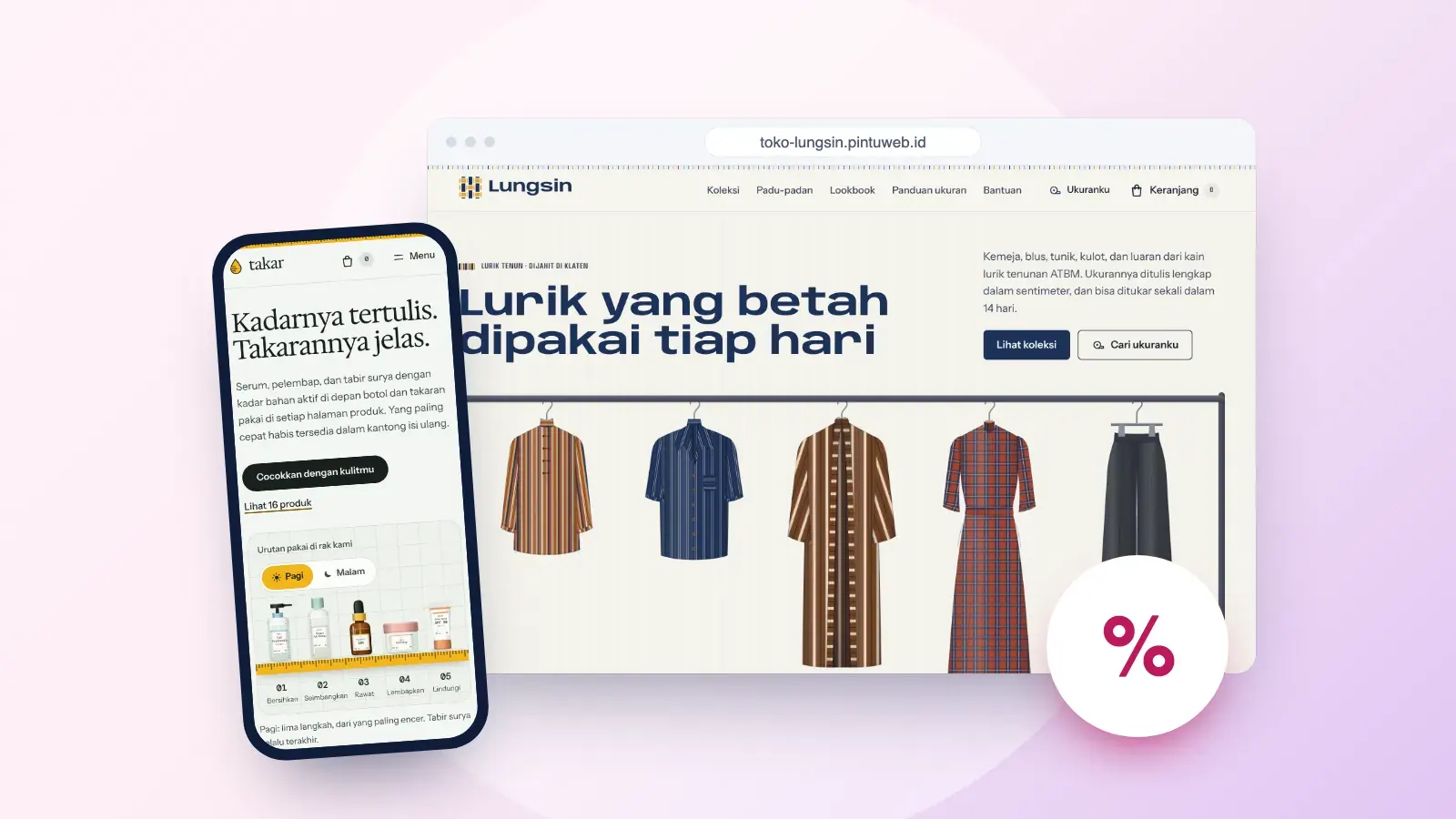
You can browse working examples in our online store gallery (in Indonesian), such as Tanur, handmade ceramics, and Takar, skincare with clearly stated concentrations. The brands are fictional; the features are real. More detail is on the online store service page.
Frequently asked questions
Is your own store always cheaper than a marketplace?
Not always. It avoids platform commission, but you pay for the build, yearly domain and hosting renewal of roughly IDR 300,000–500,000, payment-gateway fees and the promotion needed to bring visitors. Run the numbers on your own order volume and margins.
Can stock and prices stay in sync with a marketplace?
Manually, for a small catalogue. Automatic sync depends on each marketplace's API access and is usually built as a custom feature, so discuss it before ordering.
Will my own store show up on Google?
Yes. Each product page can be indexed with its own title, description and product structured data. Results build up over time and are helped by clear content and links from your social accounts and Business Profile.
Can international buyers pay through the store?
That depends on the payment gateway you choose and the methods it supports. For larger B2B orders, many sellers use a quote form and invoice instead of instant checkout.
How long does it take to build?
The Simple Online Store takes 3–5 working days and the Full Online Store 5–8 working days, counted from when product photos and details are complete.
Sources
- BPS — Menimbang Manfaat dan Risiko Penggunaan Marketplace dalam E-Commerce di Indonesia (2025) (new tab)
- TikTok Shop by Tokopedia Seller Center — Pengenalan Biaya Penjual (new tab)
- TikTok Shop by Tokopedia Seller Center — Customer Communication Policy (new tab)
- Google Search Central — Introduction to Product structured data (new tab)
AryaFounder & full-stack developer of PintuWeb. Building websites for small businesses since 2018, from the interface to the back end and database.
About the author